

Explosive strength changes how you move: it makes a jump higher, a sprint faster, and a tackle decisive. This article walks through the science, the best drills, and ready-to-use plans so you can train explosively without guessing. If you search for Упражнения для развития взрывной силы, you’ll find many lists; here I’ll connect those movements to clear principles and real-world progressions.
What explosive power really means
Explosive power is the ability to produce maximal force in the shortest possible time. Coaches often call it rate of force development (RFD), which matters more in many sports than raw maximal strength.
Physiologically, explosive actions rely heavily on fast-twitch muscle fibers, efficient neural recruitment, and tendon stiffness that stores and returns elastic energy. Training alters not only muscle size but also firing rates and coordination between muscle groups.
Understanding that distinction—force versus speed of force—helps you pick the right exercises and programming. You can be very strong but slow, or moderately strong and very explosive; training should be tailored to the movement demands of your sport or goal.
Principles of effective explosive training
Specificity is the first rule: train movements and velocities similar to your sport. If your sport requires horizontal sprint acceleration, focus on short sprints and hip-dominant explosive drills rather than vertical-only jumps.
Train with high intent and relatively low fatigue per rep. Explosive work demands maximal or near-maximal intent to recruit fast motor units, so keep sets short and rest long enough to maintain quality—often two to five minutes between heavy attempts.
Progressive overload still applies, but it looks different: add complexity, increase velocity, alter resistance, or improve technical efficiency rather than simply piling on weight. Periodize your volumes so you build foundation strength before pushing high-velocity loads.
Warm-up and mobility for high-quality efforts
A deliberate warm-up protects you and primes the nervous system for fast actions. Start with light aerobic movement, then flow into dynamic mobility that opens the hips, ankles, and thoracic spine—areas critical for powerful hip extension and trunk stability.
Include activation drills for glute medius, hip extensors, and core. Short sets of banded side steps, glute bridges, and anti-rotation presses increase muscle temperature and enhance motor control before going explosive.
Finish with movement-specific ramp-ups: progressively intense jumps, throws, or sprints at 50, 70, and 90 percent effort. These rehearsals calibrate timing and reduce the risk of poor technique under high loads.
Foundational movements: how to choose exercises
Choose exercises that target the movement pattern and velocity you need. Broadly, explosive work falls into plyometrics, weighted ballistic lifts, short sprints, and medicine ball/throwing patterns.
Prioritize base strength first: squat, deadlift, and hinge strength provide the platform to express speed. Once you have a strength base, add faster, more dynamic variations and skill-specific drills.
Variety matters, but don’t chase novelty. Rotate through a focused set of progressions—basic to advanced—and measure improvements with simple tests like vertical jump or 20-meter sprint times.
Plyometrics: jumping and reactive strength
Plyometrics train the stretch-shortening cycle—the muscle-tendon system’s ability to absorb and rapidly reapply force. They range from low-intensity hops to high-intensity depth jumps and broad jumps.
Start with two-foot vertical and horizontal hops, then add single-leg variations, bounding, and depth jumps as technique and strength allow. Ensure a soft, quick landing and immediate rebound without excessive ground contact time.
Common mistakes include overemphasizing height over technique and performing too many reps. Quality beats quantity: 50 high-quality contacts per session often offers more benefit than 200 poor ones.
Olympic lifts and their derivatives
Classic Olympic lifts—cleans and snatches—train explosive triple-extension (ankle, knee, hip) with a heavy emphasis on coordination and timing. They’re powerful tools for athletes who can learn technique safely.
If full lifts are too technical, use derivatives: hang cleans, power snatches, and high pulls transfer much of the same neural demand without requiring a deep catch. These variations allow heavier, more consistent loading for power development.
Use these lifts twice weekly for advanced athletes; for beginners, start with technique work and simpler options like kettlebell swings or jump shrugs to build the motor pattern.
Ballistics and medicine ball throws
Medicine ball throws are a simple way to train forceful, coordinated extension of the hips and trunk. They mirror sport actions like throwing, batting, and tackling because they emphasize transfer through the trunk and arms.
Include overhead throws, chest passes, rotational throws, and scoop throws. Use light to moderate weight and focus on maximal intent and snap-like coordination rather than heavy loading.
These drills are particularly useful in-season because they provoke power with lower joint stress compared to heavy Olympic lifts or high-volume plyometrics.
Sprint training and resisted sprints
Short sprints—10 to 40 meters—develop acceleration and the neuromuscular rhythm of explosive leg drive. Train sprints with full recovery so each run is high quality and fast.
Resisted sprinting (sleds, sand, or uphill repetitions) teaches force application at start velocities, while assisted sprinting (slight downhill or towing) can train maximal leg turnover. Use resistance sparingly and progressively to avoid technique degradation.
Measure splits and keep careful note of fatigue. Acceleration work should feel crisp, not grindy; if pace drops significantly, reduce volume or rest longer between reps.
Kettlebell swings and hip-hinge power
Kettlebell swings teach explosive hip extension and posterior chain timing with a simple hinge. They’re accessible and scalable for almost every athlete and can be used both for power and conditioning depending on load and tempo.
Focus on a powerful hip snap and a relaxed shoulder; the arms are followers, not drivers. Swings can be loaded heavy for low-rep power sets or lighter for higher-rep metabolic work, but separate these goals into different sessions.
I’ve found swings useful as a daily “reminder” for hip extension mechanics—an inexpensive way to maintain quality movement patterns when heavier lifting isn’t possible.
Programming explosive sessions: structure and examples
An explosive session typically begins with mobility and activation, progresses to skill/plyometric work, then moves to weighted power lifts, and finishes with conditioning or technical drills. Place these sessions when you are fresh, ideally earlier in the week and day.
Volume and intensity are inversely related in power training: high intensity calls for low competitive volume. For example, 4–6 sets of 2–5 explosive reps with long rests maintains intent and reduces injury risk.
Below are three sample templates—beginner, intermediate, and advanced—that you can adapt by sport and schedule. These are frameworks; adjust loads, rest, and exercise selection to individual needs.
Beginner template (2 sessions/week)
Session A: Dynamic warm-up; 3×5 bodyweight squat jumps; 4×6 kettlebell swings (moderate); 4x30m sprints; core stability work. Keep rest 90–180 seconds between intense sets.
Session B: Warm-up; 4×5 loaded jump squats (light load); 3×6 medicine ball overhead throws; technique work with light hang cleans or high pulls; mobility and soft tissue. Emphasize learning movement rather than heavy loads.
Progress by adding a set or increasing jump height, kettlebell load, or sprint distance every one to two weeks. Test a vertical jump every four weeks to track improvements.
Intermediate template (3 sessions/week)
Session A (strength + power): Back squat 4×4 heavy; 3×3 power cleans; 5×3 broad jumps; accessory posterior chain work. Use 2–4 minutes rest between power sets for quality.
Session B (speed and plyo): Dynamic warm-up; 6x40m sprints; single-leg bounds 4×6 each; medicine ball rotational throws 4×6. Keep volume manageable to maintain speed in all reps.
Session C (explosive conditioning): Deadlift or Romanian deadlift 3×5 (moderate); kettlebell swings 5×10; depth jumps or drop jumps 4×5; finish with mobility and activation. Ensure 48–72 hours between maximal efforts.
Advanced template (4 sessions/week)
Day 1: Max strength focus—heavy squat or deadlift variations 3–5 sets at low reps followed by ballistic squats or clean pulls for power. Limit total explosive reps to preserve CNS freshness.
Day 2: Speed and acceleration—resisted sprints, uphill work, and technical overspeed drills. Keep total sprint volume relatively low and prioritize recovery between runs.
Day 3: Olympic lift emphasis—snatch or clean derivatives coupled with plyometric linkages like multiple broad jumps or plyo push-ups. Practice complex lifts for technical and neural improvements.
Day 4: Sport-specific integration—combine medicine ball throws, reactive agility, and conditioning circuits that reflect game demands. This session bridges the gym to the field.
Progressions and regressions for each exercise
Every drill can be scaled up or down. For jumps, regress from depth jumps to two-foot hops, then to assisted jumps if needed. For Olympic lifts, regress to high pulls, then to hang variations, then to light technique-only bars.
When moving forward, change one variable at a time: load, height, distance, or complexity. This keeps adaptations measurable and prevents training spikes that invite injury.
If an athlete lacks single-leg stability, prioritize single-leg RDLs and controlled hops before unilateral plyometrics. Correct deficits first; otherwise explosive work often reinforces compensations.
Sample exercise table
Below is a concise table showing common explosive drills, primary targets, and recommended athlete level. Use it to match exercises to your needs without overcomplicating choices.
| Exercise | Primary target | Level |
|---|---|---|
| Vertical jump | Lower-body power, reactive jump | All |
| Depth jump | Reactive stiffness, high RFD | Intermediate–Advanced |
| Power clean | Triple extension, coordination | Intermediate–Advanced |
| Medicine ball rotational throw | Trunk transfer, rotational power | All |
| Kettlebell swing | Hip hinge power | Beginner–Advanced |
| Sled sprint | Acceleration force development | All |
Monitoring progress and testing
Pick two or three objective tests and repeat them every four to eight weeks. Typical tests include vertical jump, broad jump, 10–20 meter sprint, and a seated medicine ball throw for upper-body power.
Record conditions carefully: time of day, warm-up, footwear, and surface can change results. Small improvements matter; a 2–3% gain in vertical jump is meaningful for most athletes.
Use these tests to adjust programming. If speed improves but jump power declines, re-balance the mix of horizontal versus vertical work or check for insufficient recovery.
Recovery, nutrition, and tissue health

Explosive training taxes the nervous system and connective tissues more than slow lifting. Prioritize sleep, frequent protein intake, and hydration to support adaptation and repair.
Include tendon health protocols: gradual loading, eccentric work, and low-amplitude high-frequency exercises for stubborn tendon issues. Prehab like banded hip work and ankle mobility reduces chronic problems.
Manage overall workload. It’s tempting to add more jumps or sprints when progress stalls, but often the solution is rest, technique refinement, or a temporary shift in intensity rather than volume increases.
In-season vs off-season considerations
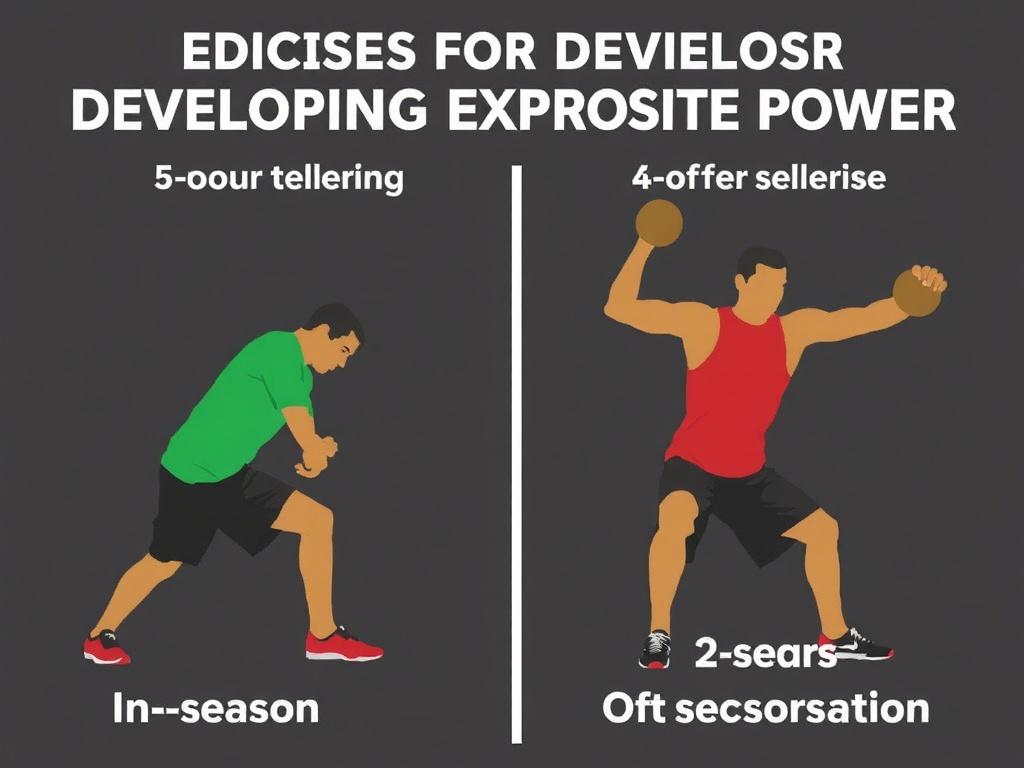
In the off-season you can emphasize heavy strength phases followed by concentrated power blocks. This sequence builds capacity that later translates into speed when velocities are higher.
In-season, maintain power with shorter, sharper sessions that preserve freshness for competition. Use medicine ball work and sprints that replicate competition demands but keep total impact low.
Match your priorities to your sport’s calendar and be conservative with novel high-impact drills close to competition. A small technical miss during a heavy plyo set can sideline you for weeks.
Common mistakes and how to fix them
Too much volume at high intensity is a frequent error. If you find technique collapsing mid-set or chronic soreness building, cut volume and prioritize full recovery between maximal efforts.
Poor technical execution often stems from insufficient strength or weak-coordination. Address deficits with basic strength and simplified variations before returning to complex ballistic movement.
Neglecting single-leg strength and stability creates asymmetries and increases injury risk. Regular single-leg RDLs, step-ups, and balance work reduce imbalances and improve transfer to single-leg sport tasks.
Programming case study: a soccer player
I coached a collegiate soccer player who needed better first-step explosiveness. We spent eight weeks strengthening the posterior chain, then transitioned to specific acceleration drills with short resisted sprints and lateral bounds.
The plan emphasized brief, high-quality efforts twice a week, combined with two general strength sessions. Within six weeks his 10-meter split improved measurably and he reported feeling more decisive in duels.
The key was matching the training to the sport: horizontal force production and single-leg stability dominated the program rather than excessive vertical plyometrics that had little carryover to his on-field role.
Practical equipment guide
You don’t need a fancy gym to train explosively. At minimum, a medicine ball, a kettlebell, and an open space for sprints let you work most of the necessary qualities.
Sleds, boxes, and barbells expand your options, but they’re optional. Soft surfaces and careful landing instruction reduce impact when you do higher-repetition plyometrics at home.
When buying equipment, think about durability and multi-use value. A 10–20 pound medicine ball covers most power work for most people, and a 16–32 kg kettlebell is a versatile single purchase for many athletes.
Safety and warm-down protocols
End sessions with mobility and light cardiovascular cooldown to aid recovery and assist tissue remodeling. Include targeted static stretching only if it’s part of a longer recovery routine rather than as a neuromuscular reset after explosive efforts.
Monitor joint pain versus normal muscular soreness. Sharp or localized joint pain requires immediate review of technique or regression of exercises. Don’t push through pain that alters movement quality.
Regularly reassess movement quality: screen squats, single-leg RDLs, and hip hinge tests can flag early deficits. Fix problems early with corrective exercises rather than compensatory load increases.
Programming details: sets, reps, and rest
For pure power moves, aim for 3–6 sets of 1–6 reps depending on the exercise and athlete level. Heavy strength sets can accompany fewer explosive reps; stamina-oriented sessions use higher reps with lighter loads but should be separated from maximal efforts.
Rest periods are often longer than traditional hypertrophy work. Two to five minutes allows sufficient recovery for the nervous system, preserving quality across sets and maximizing recruitment of fast-twitch fibers.
If fatigue accumulates during a session, reduce subsequent set intensity or end the session—quality of intent and technique matters more than hitting a prescribed number of reps.
Measuring training load without fancy tools
Track session RPE (rating of perceived exertion) and record sprint times, jump heights, and sets completed. A simple training log gives clear trends over weeks and highlights when load exceeds adaptation capacity.
Use percentage-based progression loosely: if your best vertical improves, slightly raise plyo difficulty or add a ballistic gradient. But treat percentages as rough guides rather than absolute rules for power work.
Video is a powerful free tool. Recording lifts and jumps helps identify technical issues that invisible metrics might miss, and small visual cues often explain performance swings better than numbers alone.
Upper-body explosive training
Upper-body power matters in many sports. Plyo push-ups, medicine ball chest passes, and rotational throws train the same fast-force qualities for the torso and arms as lower-body plyometrics do for the legs.
Use push-focused ballistic sets (3–5 sets of 3–8 reps) and combine them with anti-rotation holds to ensure the trunk transfers force effectively. Upper-body power also benefits from heavy compound lifts to build the underlying capacity.
Be cautious with plyo push-ups if you have shoulder issues; regress to medicine ball variations or incline ballistic presses to protect joints while still training velocity.
Long-term progression and periodization

Think in blocks: build a strength base, add power, then move to sport-specific expression. Each block should last 4–8 weeks with measurable goals and a deload week to consolidate gains.
Rotate emphases through the year to avoid plateaus: heavy strength in the off-season, mixed power in the pre-season, and maintenance in-season. This approach balances adaptation and durability over months and years.
Change one primary focus per block to create clear signals for adaptation—mixing too many priorities at once dilutes the training effect and blurs progress monitoring.
Final practical tips and coaching cues
Coach intent over position; cue “explode” or “snap through the hips” rather than “jump higher” when technique needs refinement. Intent is often the missing ingredient that turns a movement into a power expression.
Record short videos of your best reps and your worst reps. The contrast teaches more than perfection: when you see technique break down, you can trace it back to fatigue, strength deficits, or poor setup.
Consistency and small, measurable steps compound. Rare, dramatic workouts don’t replace steady, progressive work—especially when training complex qualities like explosive power.
Apply these principles and exercises with patience and attention to detail, and you’ll build speed and force that feel natural and reliable in sport. Training explosively is a craft: precise, technical, and deeply rewarding when executed well.