

Sand training can feel like stepping into a different sport: the ground gives way, your muscles wake up in new patterns, and your lungs work harder for the same pace. If you are curious about Тренировки на песке: плюсы и минусы, this article will walk you through the real advantages, the trade-offs, and how to build smart sessions that fit your goals. I’ll share practical tips, safety must-dos, and examples you can try on the next beach outing.
What counts as sand training?
“Sand training” covers any deliberate exercise performed on loose sand rather than firm ground. That can include running, sprinting, bounding, plyometrics, agility work, bodyweight circuits, and strength drills. Both wet packed sand near the shoreline and dry, deep dune sand are used, but they feel and behave very differently underfoot.
Some people do short, intense intervals on soft sand, while others use packed shoreline sand for longer tempo or endurance sessions. Understanding the surface you choose is the first step to getting benefits without unnecessary risk.
How sand changes movement: the mechanics
Sand reduces ground reaction force because it deforms under load, so your foot sinks and energy is absorbed. That makes many movements lower in impact but higher in muscular demand, especially for the calves, stabilizers around the ankle, and the hip complex. Your stride becomes shorter and cadence often increases naturally.
At the same time, the instability forces more neuromuscular recruitment. Your brain and muscles must constantly adjust to micro-shifts underfoot, which improves balance and proprioception if trained progressively. This combination of reduced impact and increased muscular work is the foundation of sand training’s appeal.
Benefit: reduced joint impact and safer landing forces
Because sand cushions landing, it lowers peak impact forces compared to running or jumping on asphalt. For athletes and exercisers managing joint pain—particularly in the knees and hips—sand can provide a gentler environment for speed and plyometric work. That doesn’t make it risk-free, but it often lets people do higher-intensity sessions with less pounding.
Rehab professionals sometimes use sand to reintroduce loading gradually after injury. The softer surface allows controlled exposure to dynamic movements while decreasing sharp jolts that could aggravate healing tissues.
Benefit: higher muscular demand and strength endurance

On sand you recruit more muscle fibers to stabilize and push through a yielding surface. The calves, glutes, hamstrings, and core all work harder to maintain forward momentum and balance. Over weeks, that added demand builds strength endurance and local muscular resilience that transfers back to firmer surfaces.
For athletes who need explosive strength in unstable environments—think beach volleyball, soccer players training for quick direction changes, or trail runners—this specific overload can be particularly useful.
Benefit: greater calorie burn for the same pace
Because locomotion on sand requires more energy per step, you burn more calories at a given speed than on pavement. That makes sand workouts attractive for people aiming to increase metabolic load without extending training time. Intervals and circuits on sand can be efficient conditioning sessions when time is limited.
This increase in energy cost comes from both the extra muscular work and the inefficiencies of pushing off a moving surface, so even steady-state efforts feel tougher and more productive.
Benefit: improved balance, proprioception, and injury prevention
Sand’s instability forces small corrective actions from the ankles, knees, and hips, sharpening proprioceptive awareness. Those adaptations can reduce the likelihood of ankle sprains and other perturbation-related injuries when properly integrated into a program. Balance improvements are also helpful for older adults who want safer strength and gait.
That said, benefits for injury prevention depend on sensible progression—sudden exposure to deep sand with no preparation can backfire and cause overuse or acute injuries instead of preventing them.
Benefit: variety, motivation, and mental freshness
Training in a new setting can break monotony and boost motivation. The sights, sounds, and tactile feedback of sand provide sensory novelty that keeps sessions interesting. For people who struggle to maintain consistency, a beach session once or twice a week often improves adherence to an overall program.
Workouts that feel fun and different are more likely to be repeated, which is a practical benefit that matters for long-term progress.
Drawback: specificity and transfer to firm surfaces
Sand is a dramatically different surface, and heavy training on it can reduce specificity for sports that occur on firmer ground. Sprinters or field athletes who do most of their speed work on sand may notice slower times when returning to the track. Gains in sand do not always translate directly to improved performance on turf or asphalt.
You should integrate sand sessions strategically, not replace all sport-specific work with them. Use sand as a complement rather than a wholesale substitution unless you compete on sand frequently.
Drawback: altered biomechanics and potential overuse
Sustained sessions on sand change stride length, knee angles, and joint loading patterns. Those changes are useful in moderation, but if you perform high volumes of sand work without balancing training, you can overstress previously underused muscles and tendons. The Achilles and plantar fascia are particularly vulnerable to sudden increases in load.
Progress slowly and include recovery days or cross-training on firmer surfaces to avoid chronic irritation from repetitive, unfamiliar movement patterns.
Drawback: uneven surfaces and acute injury risk
Deep sand hides surprises: holes, shells, glass, and sudden drop-offs. Twisted ankles, lacerations, and trips are real hazards when you don’t scout your area beforehand. Wet packed sand is generally more predictable, but shoreline currents and tides change the terrain daily.
Take time to inspect a training area, choose a clear strip for repeated sprints, and wear protective footwear when the environment is uncertain.
Drawback: practical inconveniences
Sand gets everywhere and affects clothing, shoes, and devices. Water, sunscreen, and sweat combine with sand to make equipment grimy and sometimes unusable. Some gyms and facilities will not appreciate sand-covered shoes and towels brought back from a session.
Plan logistics: a dedicated bag for sandy items, a towel for equipment, and a clean pair of shoes to switch into for the trip home will reduce friction in your routine.
Who benefits most from sand work?
Athletes who need improved stability, power endurance, and reduced impact—beach volleyball players, soccer and rugby athletes, trail runners, and team-sport players—often gain a lot from targeted sand sessions. Recreational exercisers looking for variety, lower-impact plyos, or higher-effort conditioning with less jarring will also find value.
Beginners should be cautious: while sand is forgiving on joints, the sudden neuromuscular demand can be an overload if someone jumps straight into intense sand intervals without foundational strength and balance training.
Who should avoid or limit sand workouts?
People with acute foot, ankle, or lower-leg injuries should avoid deep sand until cleared by a healthcare professional, because the instability can exacerbate certain conditions. High-performance sprinters in peak competition season should also limit sand volume to avoid losing speed specificity or risking tendon irritation.
Anyone with balance impairments or advanced neuropathy should consult a clinician before beginning extensive sand training and might be better off using packed sand or supervised exercises first.
How to start: progression principles
Begin with short exposures on packed or lightly moist sand and focus on technique, not max effort. Start with walking, then brisk walking, then short jogs, before adding intervals. Keep early sessions brief—15 to 20 minutes of mixed activity—and allow two to three days between intense sand workouts for novice trainees.
Progress by increasing volume slowly, adding sets or time rather than suddenly increasing intensity. Listen to your body: persistent soreness in unfamiliar areas is a sign to back off and add more recovery.
Basic sand exercises to try
Simple, effective drills that illustrate sand’s unique demands include short sprints (10–40 meters), bounding, single-leg hops, lateral shuffles, and bodyweight circuits with lunges, squats, and planks. Use short rest intervals to emphasize conditioning, or longer rests to focus on power development.
Here is a sample list of exercises to combine into a session:
- 10–20 meter sprints (shoreline, packed sand)
- Alternating forward bounds (5–8 reps per set)
- Single-leg hops in place (6–10 per leg)
- Lateral shuffles for 10–15 meters
- Walking lunges for 20–30 meters
- Plank holds and side planks for core stability
Sample sessions for different goals
Below are three compact templates you can adapt. Each is intentionally short to minimize risk while delivering targeted stimulus. Warm up thoroughly and cool down after every session.
- Strength endurance: 4 rounds of 40 seconds work, 20 seconds rest — alternating walking lunges, bodyweight squats, plank, and mountain climbers.
- Speed and power: 6 × 20 m sprints with full recovery, followed by 3 sets of 6 bounds and single-leg hops.
- Conditioning: 20-minute circuit alternating 2 minutes of steady jog with 1 minute of high-effort lateral shuffles and 1 minute of rest.
Programming: frequency, volume, and integration
For most people, one to two focused sand sessions per week is sufficient to reap benefits without interfering with performance on firmer surfaces. Competitive athletes might add a third session during the off-season when specificity is less urgent and general capacity building is the priority.
Use sand training as a component of a balanced plan that includes strength work in the gym, mobility, and sport-specific practice on the appropriate surface. Sand is a tool—use it for a phase of training, then taper or change it up according to your calendar.
Footwear, barefoot, or minimalist shoes?
There is no single right answer for every person. Barefoot or minimalist shoe work increases proprioceptive feedback and foot strength but also raises the risk of cuts, hot sand burns, and acute overloads. Many athletes prefer low-profile, well-draining shoes that protect the foot while maintaining close ground feel.
If you decide to go barefoot, start on packed, cooler sand and keep sessions very short. Change to shoes for deeper or rough terrain, and rinse footwear soon after to remove abrasive salt and sand that can degrade materials.
Warm-up and mobility routines for sand
A dynamic warm-up is essential because sand demands more stabilization and places different stresses on joints. Include 5–10 minutes of dynamic drills: leg swings, hip circles, walking lunges, ankle mobility work, and light jogging. Add activation exercises for the glutes and core to prime movement patterns.
Finish the warm-up with a few submaximal sprints or bounding reps on the sand to let your nervous system adapt before full efforts. This reduces the chance of sudden overload when you go hard.
Safety checklist before you train
Perform a quick site inspection for hazards such as broken glass, sharp shells, and hidden holes. Check tide charts and weather conditions to avoid getting stranded or working on unstable, shifting edges. Carry water and a charged phone, and let someone know where you’ll be if you’re training alone.
- Inspect the area for debris and hazards
- Choose packed sand for higher-speed drills
- Bring water, sunscreen, and a towel
- Warm up thoroughly and start slow
Equipment and clothing tips
Choose clothes that dry quickly and won’t weigh you down when wet. Compression shorts and quick-dry shirts work well. Sunglasses and a hat protect against glare and sunburn, and thin, breathable shoes with drainage help protect the foot while minimizing sand retention.
Bring a small backpack or dry bag for valuables, and a separate mesh bag for sandy items. A lightweight resistance band can add a strength element to warm-ups or mobility work on the beach.
Monitoring progress and avoiding plateaus
Track objective measures like time for a fixed distance, number of quality bounds, or total session duration to assess improvement. Because sand sessions can be more variable, maintain consistency with benchmarking runs on the same strip of sand and at similar tide conditions to get reliable comparisons.
Mix intensities and use periodization: alternate higher-volume phases of sand-based endurance work with strength-focused blocks or speed-focused blocks on firm ground to continue progressing across qualities.
Common mistakes and how to avoid them
A frequent mistake is doing too much too soon: long, intense sand sessions after a week of rest often lead to soreness and tendon irritation. Another error is neglecting technique—short strides and a higher cadence typically work better in sand, but many people try to maintain their usual stride length and end up wasting effort.
Avoid training tired on deep sand, because fatigue increases the chance of missteps and acute injury. Use sand when you’re fresh if the session includes high-speed or power elements.
Rehabilitation uses and clinical perspectives
Clinicians sometimes use sand to progress patients between non-weight-bearing and full ground work because it allows graded loading. Exercises on sand can rebuild strength, neuromuscular control, and confidence without the full peak loads that provoked the injury initially. Progress should follow clinician guidance to prevent setbacks.
For some conditions, such as early tendon rehabilitation, sand’s increased muscular demand but lower peak ground reaction can be ideal. However, careful monitoring of symptoms and slow progression remain crucial.
Comparing wet packed sand and dry loose sand
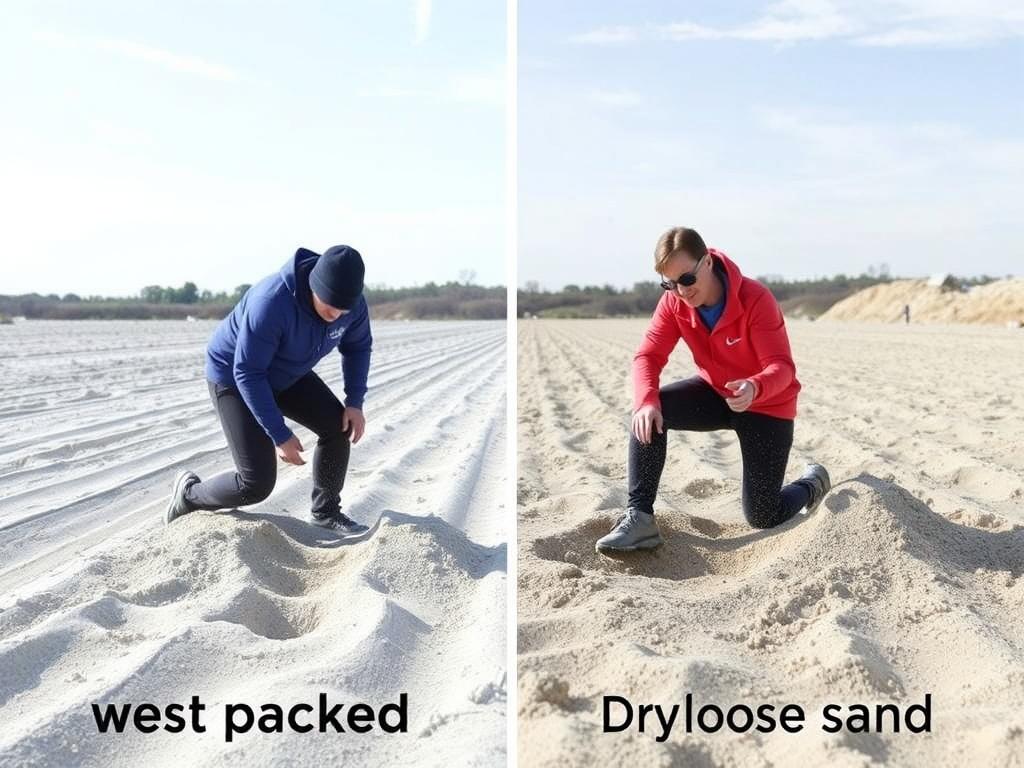
Wet packed sand near the shoreline is firmer and better for speed drills, while dry loose sand increases instability and muscular demand. Choose the surface based on session goals: packed sand for faster running and technique drills, loose sand for strength endurance, balance, and metabolic load.
Because conditions shift with tides, planning to train close to a consistent zone prevents surprise differences between sessions and improves training reliability.
Real-life examples: what coaches do
Many coaches schedule sand workouts as part of a multi-week microcycle focused on durability or recovery-conscious conditioning. For instance, a soccer coach might replace one high-impact turf session with a sand circuit to maintain conditioning while reducing joint stress before a busy match schedule. Strength coaches use sand circuits to create loaded but low-impact metabolic sessions for off-season conditioning.
These real-world adaptations show that sand is a flexible tool in the coach’s toolbox when integrated thoughtfully with the wider training plan.
My own experience on sand
I’ve used sand sessions for three off-season cycles with local club players, alternating packed-sand speed days with loose-sand conditioning. Early on, athletes reported unusual calf and glute soreness, but by week three they were moving more confidently and with improved endurance. When we returned to turf, the players felt more resilient and less sapped by repeated high-intensity bouts.
That hands-on experience taught me the value of short, progressive exposures and the importance of pairing sand sessions with gym-based strength work to support tendons and joints through the novel loads.
Scientific findings: what the research generally shows
Research on sand training broadly supports the anecdotal observations: it reduces peak impact forces, raises metabolic cost, and alters muscle activation patterns. Studies often find improved local muscular endurance and balance after focused sand training phases, although direct transfer to maximum sprint speed on hard surfaces is mixed and depends on program design.
Overall, the evidence suggests sand is useful for specific adaptations rather than as a universal replacement for surface-specific training.
When to prioritize sand and when to back off
Prioritize sand in the off-season, during recovery phases, or when joint load must be reduced without sacrificing intensity. Back off from frequent sand speed work in late competition phases where on-field speed and mechanical specificity are critical. Listen to recovery markers—persistent soreness, sleep disruption, or decreased performance are signs to reduce exposure.
Use sand strategically rather than as an all-season solution if your sport primarily takes place on firm ground.
Practical calendar: sample 4-week block
Week 1: One short sand session for acclimation (20 minutes light effort). Week 2: Add one packed-sand speed day plus one loose-sand conditioning session. Week 3: Maintain two sessions, increase sprint volume slightly, integrate gym strength work. Week 4: Deload—replace one sand day with mobility and technique work on firm ground. Repeat or progress based on goals and recovery.
This simple block shows how sand can be introduced and scaled without overwhelming the rest of the training plan.
Tracking recovery and signs of overuse
Keep a simple log of session intensity, muscle soreness, and sleep quality to spot trends. If soreness migrates from transient to persistent, or if you feel weaker rather than stronger after a series of sand sessions, reduce volume and increase recovery modalities. Consider contrast water therapy, extra sleep, and nutritional attention during heavier sand phases.
If pain is sharp or joint-focused rather than muscular, seek professional assessment rather than pushing through it—sand can mask problematic signs until an acute issue emerges.
How to combine sand with gym strength work
Use the gym to build baseline strength and tendon tolerance before ramping up sand volume. Heavy lifts, eccentric loading, and calf-strength work support the demands that sand places on the lower leg. Pairing two sand sessions per week with one to two targeted gym sessions provides balance and protects against overuse.
Focus on compound lower-body movements, single-leg strength, and core stability to maximize transfer from gym work to sand performance.
Measuring success beyond numbers
Not all progress shows up in stopwatch times. Improved balance, reduced joint discomfort during daily life, increased confidence in change-of-direction, and greater enjoyment of training are valid measures of success. Keep subjective notes alongside objective metrics to get a full picture of whether sand work is working for you.
Sometimes the best indicator is simply feeling fresher and more capable on another surface after a sand block—that’s a practical win even if sprint times haven’t spiked yet.
Quick reference table: pros and cons at a glance
Use this compact comparison when deciding whether to schedule a sand session.
| Pros | Cons |
|---|---|
| Lower peak impact forces | Less specificity for firm-surface speed |
| Higher muscular and metabolic demand | Greater risk of unfamiliar overuse |
| Improves balance and proprioception | Uneven terrain and hazards |
| Variety and motivation boost | Logistical inconveniences (sand cleanup) |
Seasonal considerations
In warm climates, heat and sun add additional stressors to sand training; schedule sessions in cooler parts of the day to reduce thermal strain. In colder regions, wet packed sand may be best outside of winter months due to frozen or dangerously soft conditions. Be adaptable and use seasonal factors to guide surface and session choices.
The environment around sand often dictates the safest and most effective version of the workout you should do at any given time.
Final thoughts and a practical invitation
Sand is a powerful, versatile training surface that deserves a place in many programs—but it works best when used intentionally. Think in terms of phases: use sand to build resilience, improve balance, and boost metabolic load without extra pounding, and then translate those gains back to sport-specific work on firm ground. Small, consistent doses of sand training usually outperform erratic, overzealous sessions.
If you have access to a safe strip of packed shoreline, try a short acclimation session this week—10 minutes of dynamic warm-up, 6 submaximal sprints of 20 meters, and a brief set of bounds. Track how your legs feel over the next 48 hours and adjust accordingly. With cautious progression, sand might become one of your favorite training tools.