
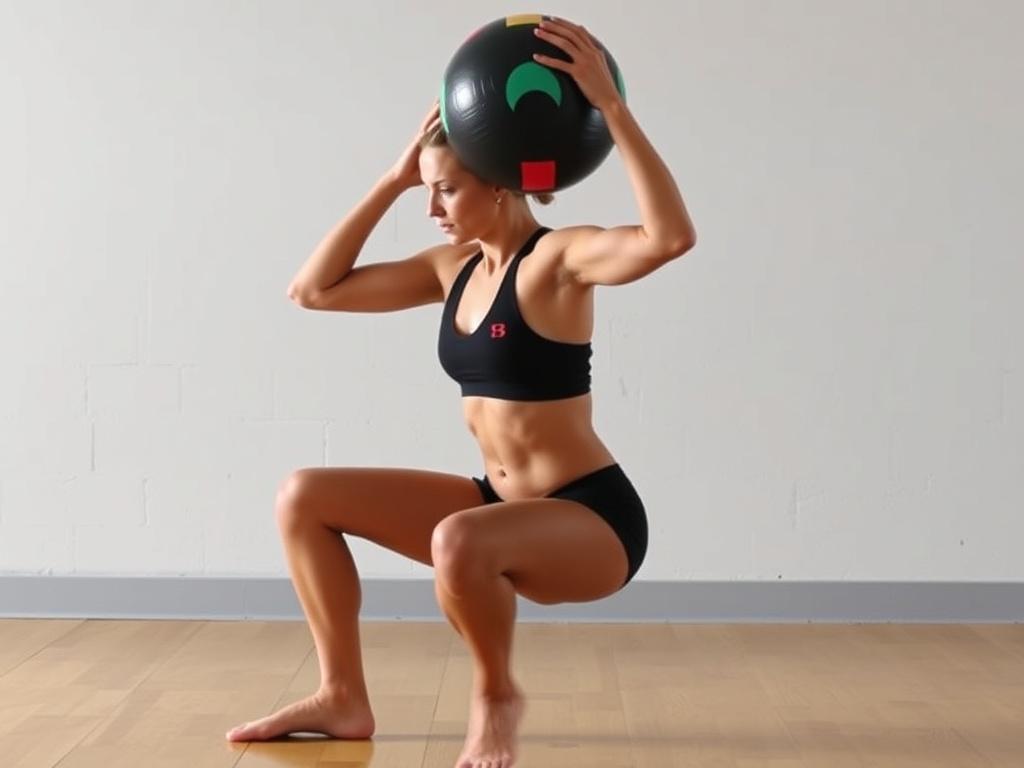
Medicine balls are compact, honest tools that demand coordination, force, and attention—qualities that make them a perfect choice for full-body conditioning. If you’re curious about Тренировки с медболом для всего тела, this article will take you from basic grips to complex circuits in a clear, practical way. Expect technique cues, sample workouts, programming tips, and real-world coaching notes that you can use immediately.
Why the medicine ball deserves a place in your routine
The medicine ball is deceptively simple: a weighted sphere that can be caught, thrown, slammed, pressed, or held. That simplicity translates into versatility; a single ball lets you train strength, power, endurance, and mobility without elaborate set-ups. Because the object moves through space and often changes hands or direction, it develops coordination and core stability in ways that static weightlifting doesn’t.
Unlike heavy, slow barbell lifts, med ball movements often require speed and timing, bridging the gap between strength and sport-specific power. They are also joint-friendly when used correctly, since many drills distribute force through the entire body and allow natural, multi-planar movement. For many athletes and everyday exercisers, med ball work produces rapid improvements in explosive capacity and functional strength.
Anatomy of a medicine ball: choosing the right tool
Medicine balls come in different materials, sizes, and weight distributions, and each type suits a different purpose. Leather or vinyl balls with a firm core are great for chest passes and catches; soft slam balls have a non-bouncing design for repeated ground strikes; weighted rubber balls work well for rotational throws and partner drills. Knowing the differences saves you from buying gear that doesn’t match your goals.
Weight selection matters more than you might think. A ball that’s too light won’t challenge your power output, while a ball that’s too heavy will force poor technique and slow movement speed. For most people, a starting weight range of 4 to 12 pounds works for ball throws and slams; stronger athletes often progress to 14–30 pounds for throws, overhead moves, and loaded carries. Test the ball: you should be able to move quickly and maintain control.
Types and construction
Traditional leather medicine balls often have a leather or synthetic cover stitched around a sand or rubber core, which gives a solid but slightly springy feel. Slam balls are typically dense rubber or composite materials with low rebound so that energy dissipates on impact, making repeated slams safe and effective. Wall balls—often used in CrossFit—are softer, designed to rebound predictably against a target.
Some modern options include water-filled or sand-filled medicine balls, which shift weight and create instability for advanced balance and core work. Consider durability, grip, and bounce when choosing a ball, especially if you plan to perform overhead throws or use the ball outdoors. A textured surface helps with sweaty hands, and reinforced seams last longer under partner catches.
Choosing the right weight and size
Begin by selecting a ball that allows you to maintain speed and form through the entire movement. For dynamic throws and slams, aim for a weight that challenges you for 8–15 explosive reps without breaking technique. For static holds, carries, and loaded squats, choose heavier options that permit 6–12 controlled repetitions. The ideal weight will differ between exercises and between athletes, so keep multiple balls if possible.
Size can also matter for hand placement. Smaller balls are easier to grip tightly and move fast; larger balls are better for chest passes and full-body catches. If you’re training for sports that involve catching or tossing an object—basketball, baseball, or rugby—practice with a size that mimics game feel. When in doubt, prioritize control over novelty: a lighter ball moved explosively beats a heavy ball that forces slow, sloppy mechanics.
Core movement patterns to master
Medicine ball training is most effective when it taps into primary human movement patterns: squat, hinge, lunge, push, pull, carry, and rotation. Each throw or slam typically combines multiple patterns, which is why med ball work yields so much bang for the training buck. Learn the patterns and the most transferable exercises, then build sessions around them.
Speed and intent change everything. A squat performed with a slow, heavy barbell targets maximal strength through high load and slow tempo, whereas med ball squat throws add velocity and require the whole body to accelerate a mass. That velocity trains fast-twitch recruitment and power expression at functional ranges of motion.
Throwing and slamming
Throws and slams teach you to produce force quickly and to transfer energy from the ground through your hips and torso into the ball. They require hip drive, a braced core, and clean release mechanics. Master simple two-handed slams and chest passes before attempting single-arm rotational throws or partner hand-offs.
Technique matters: start with your feet planted hip-width apart, generate power from the hips, and keep your neck neutral to avoid hyperextension. After you release the ball, follow through with your hands toward the target and then recover under control for the next rep. Repetitive slams are taxing—monitor your breathing and quality of movement rather than chasing numbers.
Rotational chops and passes
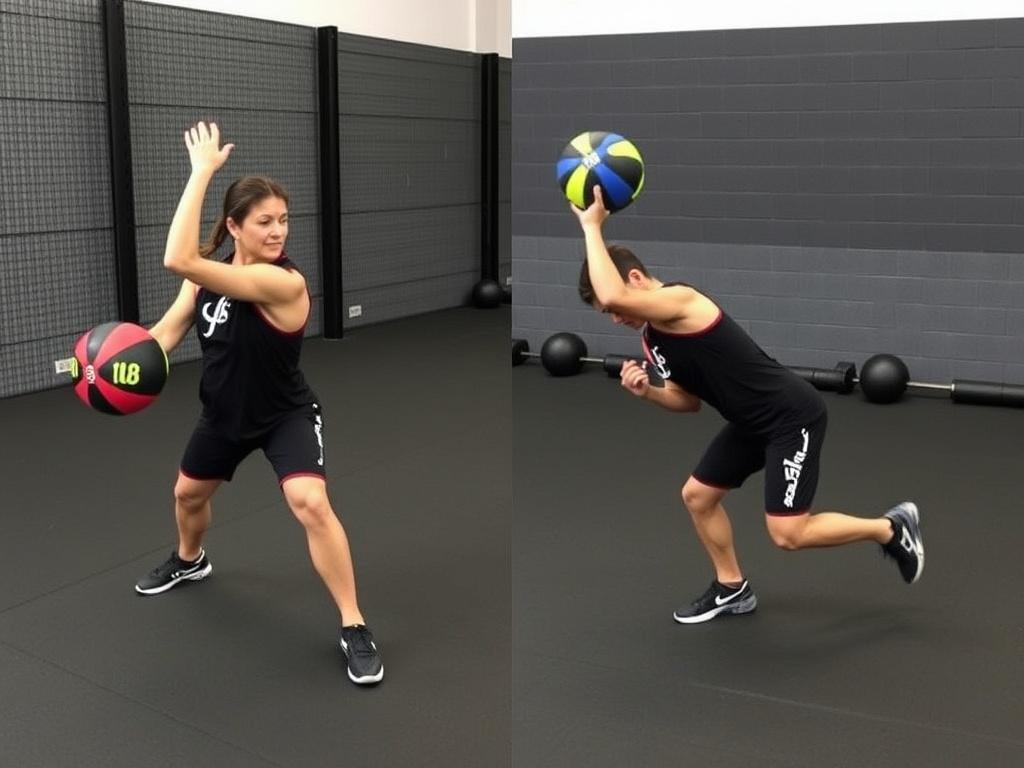
Rotational medicine ball drills—chops, throws, and wall passes—are invaluable for athletes because they mimic the twist-driven power used in throwing, swinging, and striking sports. They train the obliques, transverse abdominis, and hips to coordinate in a single, explosive pattern. Pair them with anti-rotational work to build balanced torso strength and injury resilience.
For safe rotations, pivot through your feet rather than forcing the torso to over-rotate. Use your legs and hips to initiate the movement, letting the ribcage follow. Start with lower force and build range as your joints adapt; sudden, maximal rotation without adequate mobility or technique invites lower back strain.
Squats, lunges, and loaded carries
Medicine balls can be held at the chest, overhead, or in a racked position to increase the demand of bilateral and unilateral leg work. Hold a med ball while squatting to promote upright posture and increase core recruitment, or carry it in a farmer-carry style to tax the grip and unilateral stability. Lunges with a twist or overhead hold challenge balance and functional strength in a compact package.
Using the ball forces you to stabilize asymmetries more than a barbell does—small shifts in weight distribution require micro-adjustments from your hips, knees, and ankles. That makes med ball-loaded lunges and carries a powerful tool for correcting movement imbalances and translating strength into usable movement patterns.
Twelve essential medicine ball exercises for full-body training
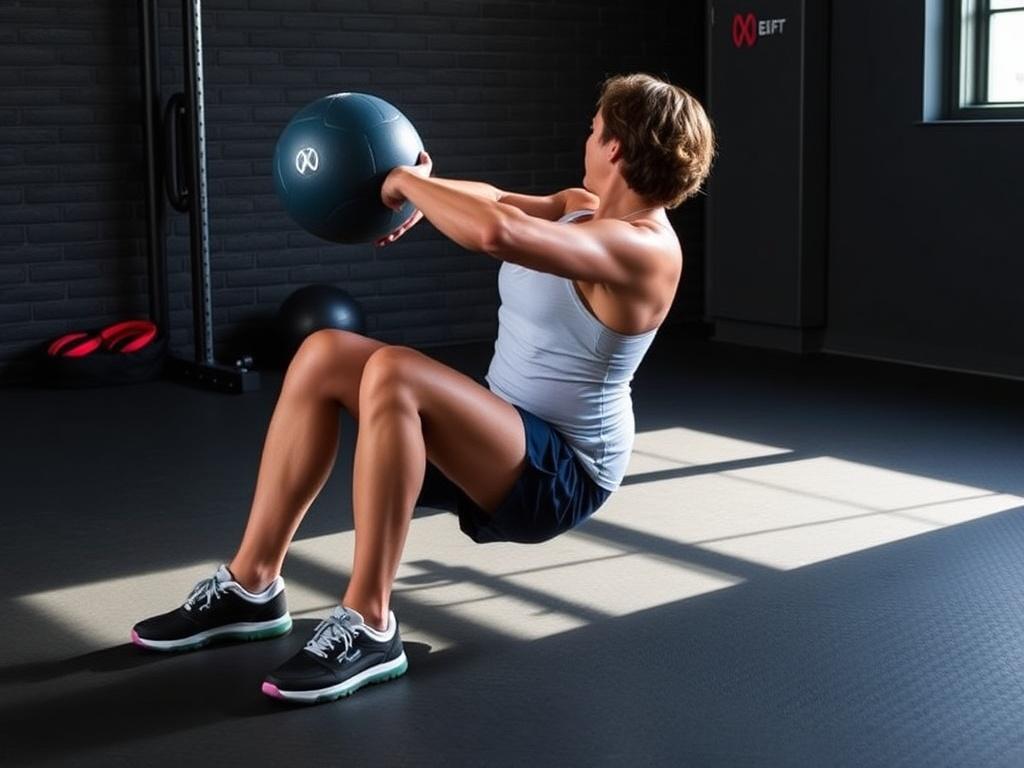
Below is a concise table that maps accessible med ball movements to their primary targets and practical coaching cues. Use it as a quick reference while you learn the drills.
| Exercise | Primary muscles | Coaching cue |
|---|---|---|
| Two-handed slam | Hips, core, shoulders | Explode from the hips; exhale on impact |
| Chest pass (partner or wall) | Chest, triceps, upper back | Step into the pass; extend through fingers |
| Rotational throw (side throw) | Obliques, glutes, quads | Drive hips into the throw; follow through |
| Overhead slam | Shoulders, lats, core | Reach tall, use shoulder rhythm, protect neck |
| Squat to press | Quads, glutes, shoulders | Explode from the legs, press at the top |
| Walking lunge with twist | Glutes, quads, core | Keep torso tall; rotate from the ribs |
| Russian twist | Obliques, transverse abdominis | Move with control; avoid excessive momentum |
| Overhead carry | Shoulders, core, traps | Pack shoulders; neutral spine |
| Med ball burpee with throw | Full body—cardio, legs, chest | Keep transitions smooth; maintain pace |
| Single-arm slam | Obliques, shoulders, hips | Brace the core; powerful hip drive |
| Wall ball | Quads, shoulders, core | Sit back into hips; aim at target consistently |
| Figure-8 pass | Core, shoulders, grip | Move the ball smoothly around the legs; small steps |
Two-handed slam
The two-handed slam is a fundamental release drill that teaches full-body coordination and breathing rhythm. Start tall, dip at the hips, then extend explosively, driving the ball toward the ground with both hands and exhaling on contact. After the ball bounces, pick it up with a controlled hinge and repeat, prioritizing quality over speed.
Progress this drill by increasing sets, adding a lateral step before each slam, or using a heavier ball once your form is solid. Avoid hyperextending the neck; keep your gaze neutral and let your hips do the work. For athletes, 3–6 sets of 8–12 reps adds power capacity without heavy spinal loading.
Chest pass
Chest passes are simple but potent for developing upper-body power and reactive catching mechanics. Use a partner, a rebounder, or a wall target and emphasize stepping into the pass to create force from the legs. Catch with soft hands, absorb the ball into your chest, and immediately execute the next pass to build rhythm.
Work on shot variability—alternate explosive throws with controlled, longer-distance passes to train different force levels. For sports players, performing chest passes with a directional step improves footwork and timing in game-like contexts. Keep shoulders active and avoid shrugging at release.
Rotational throw
Stand sideways to a wall or partner, coil your hips, and drive your back leg through the ground into a sideways throw. The goal is to transfer torque from the lower body through the torso into the ball, simulating the mechanics of a punch, swing, or throw. Use a lighter ball initially to focus on speed and coordination before adding load.
Make sure you pivot through your feet to protect the knee and lower back. Practice both sides evenly to maintain balance in rotational strength. For an extra challenge, perform the throw after a short sprint or as a finisher in conditioning work.
Squat to press
This compound move combines lower-body acceleration with upper-body pressing, teaching you to sequence powerful leg drive into an overhead press. Hold the ball at your chest, descend into a controlled squat, and explode upward while pressing the ball overhead at the top. Breathe naturally, exhaling during the press to stabilize the core.
Start with moderate weight to learn clean timing between the hip drive and shoulder press. Increase reps for conditioning or weight for strength-oriented sets. To reduce shoulder strain, use a full-body rhythm and avoid locking the elbows aggressively at the top.
Sample workouts for different levels
Below are three progressive med ball workouts designed to target the entire body. Each one balances strength, power, and metabolic work, and can be completed in 20–40 minutes depending on rest intervals and rep schemes. Use these as templates and adjust sets, reps, or weights to match your current fitness level.
Beginner: foundational power and endurance
Warm up for 5–8 minutes with dynamic mobility—leg swings, torso rotations, and light jogging. Perform 3 rounds of the following circuit with 60–90 seconds rest between rounds: 10 two-handed slams, 12 goblet squats holding the med ball, 10 chest passes (partner or wall), and 20 seconds of Russian twists. Focus on steady pacing and solid technique.
Finish with a 5-minute cool-down of light stretching and deep diaphragmatic breathing. For beginners, 2–3 sessions per week using this format builds base strength and teaches essential movement patterns. Increase either rounds or ball weight gradually to continue making gains.
Intermediate: power and conditioning blend
Begin with a 10-minute mobility and activation routine emphasizing hip hinge, shoulder mobility, and core bracing. Complete 4 rounds of 30 seconds work, 15 seconds rest for a superset: med ball slams into immediate overhead carries for 20 meters, followed by 12 walking lunges with a twist. Rest 90 seconds between rounds. Then perform a strength cluster: 3 sets of 8 squat-to-press with a heavier ball, resting 60–90 seconds.
This workout blends metabolic conditioning with heavier strength sets, improving both endurance and force production. Add one extra round or heavier ball every two weeks, but respect recovery; this intermediate stage is where overreaching is most likely without proper sleep and nutrition.
Advanced: sport-focused power circuit
Warm up with plyometric drills, dynamic mobility, and medicine ball throws at submaximal intensity for 10 minutes. Perform 5 rounds of the following complex: 8 rotational throws each side to a wall, 6 single-arm slams each side, 6 med ball burpees with a forward throw, and 30 seconds of figure-8 passes. Rest two minutes between rounds and prioritize maximal quality on each explosive rep.
Finish with two heavy sets of overhead carries for 40 meters to build core resilience under load. Advanced athletes can program this 1–2 times per week alongside barbell strength work, using med ball sessions to sharpen speed and power without taxing the spine with heavy axial loads.
Programming principles and safety
Effective medicine ball programming balances intensity, volume, and movement variety. Because many med ball drills are explosive, manage frequency to avoid CNS fatigue—two to three focused med ball sessions per week is plenty for most people. If med ball work is supplemental to heavy lifting, reduce volume; if it’s your primary training modality, you can increase frequency but vary intensity.
Always begin dynamic warm-ups that prime the hips, shoulders, and thoracic spine. Explosive med ball drills demand a responsive nervous system and mobile joints; jump straight into maximal slams without an activation phase and you’ll risk strain. Safety also includes correct footwork, neutral cervical alignment, and proper footwear or surface to prevent slips during high-velocity throws.
Managing load and progression
Progress med ball work smartly by manipulating weight, speed, volume, or complexity. Start with lighter weights and faster movements to train power, then add mass to build strength and endurance. Progress complexity by adding unilateral variations, unstable surfaces, or sport-specific sequences. Always increase only one variable at a time to track what delivers results.
Track your work in simple terms—number of explosive reps, rounds, or total throws—rather than chasing arbitrary heavier weights. For many adaptations, increasing movement quality and intent yields faster gains than simply adding weight. Recover actively with mobility work and controlled breath after intense med ball sessions.
Common mistakes and corrections
Common faults include using the arms to throw instead of driving with the hips, rounding the lower back during slams, and neglecting to breathe on exertion. Address these by cuing hip drive, bracing the core before each repetition, and exhaling on the aggressive phase of the movement. Film a few reps to self-check posture and sequencing.
Another frequent issue is poor footwork in rotational throws—athletes often rotate through the knees or try to force the torso, which strains the lower back. Fix it by teaching a proper pivot step, emphasizing hip rotation, and decreasing range of motion until the coordination is consistent. If shoulder pain arises, reduce overhead volume and focus on thoracic mobility and scapular control.
Integrating med ball work with strength and cardio
Medicine ball training complements traditional lifting and conditioning rather than replacing either. Use med ball circuits as a dynamic warm-up before Olympic lifts, or place them as a high-power finisher after strength work to train speed without adding heavy axial loading. They also pair well with sprint intervals and agility drills for sport-specific sessions.
For people focusing on hypertrophy, include med ball-loaded carries and slow-tempo presses to add metabolic stimulus without replacing heavy compound lifts. For athletes aiming at explosiveness, schedule med ball days before heavy skill work or on light days to maximize neural freshness. The key is matching med ball intensity with the rest of your program to prevent training interference.
Recovery, mobility, and injury prevention
Because many med ball drills are ballistic, recovery protocols are essential: prioritize sleep, protein intake, and active recovery. Include mobility sessions for the hips, thoracic spine, and shoulders to maintain range of motion and reduce compensatory movements. Simple daily practices like foam rolling, banded shoulder distractions, and deep breathing help keep you ready for power work.
Pre-hab exercises such as band pull-aparts, side planks, and hip hinge drills reduce the risk of common med ball-related issues. Use progressive loading and give your nervous system time—especially when adding fast, maximal efforts. When soreness occurs, reduce volume and maintain movement quality rather than pushing through pain that alters mechanics.
Real-life examples from coaching and practice
In my coaching experience, a middle-aged client with a desk job regained functional speed and pain-free rotational movement through consistent med ball work. Starting with light rotational throws and tolerance-building slams, she progressed to carries and explosive chest passes, which translated into easier movements during tennis and household tasks. The med ball replaced repetitively painful exercises with dynamic, multi-planar motion that felt immediately useful.
On the athletic side, a collegiate lacrosse player improved shot velocity by combining Olympic lifts with med ball rotational throws twice per week. The med ball sessions sharpened transfer from the hips into the upper body and noticeably increased his transfer of power on the field. These real-life wins underscore how med ball drills improve sport-specific mechanics when integrated with strength training.
Equipment checklist and buying guide
Start with two or three medicine balls of different weights: a light ball for speed (4–8 lbs), a medium ball for mixed power (8–14 lbs), and a heavier ball for loaded carries and squats (14–30 lbs). If budget allows, add a non-bouncing slam ball for repeated ground impacts and a wall ball for target throws. Prioritize quality materials and a textured grip surface to prevent slipping during sweaty sessions.
Keep your training area safe: a rubber mat or turf reduces bounce and protects floors during slams, while breathable space avoids collisions during rotational throws. If training with a partner, use a wall or rebounder to practice solo passes safely. Store balls out of direct sunlight to lengthen life and prevent seams from splitting.
Recommended basics
- Light med ball (4–8 lbs) for speed work and skill acquisition.
- Mid-weight med ball (8–14 lbs) for most rotational throws and slams.
- Heavy med ball (14–30 lbs) for carries, loaded squats, and strength endurance.
- Slam ball with low rebound for floor slams and high-volume work.
Having variety allows you to tailor workouts to goals and to progress safely. You can also improvise with household objects for occasional variety, but invest in at least one quality ball designed for repeated throws to maintain consistent feel and safety.
Sample weekly plan incorporating med ball work
This sample week balances med ball sessions with strength and recovery to optimize progress for most recreational athletes. Adjust volume and intensity based on your schedule and recovery capacity, keeping med ball work purposeful rather than simply filling time. The goal is to build power and functional strength while minimizing overuse.
| Day | Focus | Med ball role |
|---|---|---|
| Monday | Lower-body strength | Light med ball warm-up throws and 3 sets of squat-to-press as finisher |
| Tuesday | Power/conditioning | Heavy med ball circuit with slams and rotational throws |
| Wednesday | Active recovery | Mobility plus light figure-8 passes for core activation |
| Thursday | Upper-body strength | Chest passes and overhead carries as accessory work |
| Friday | Sport-specific or HIIT | Med ball complex integrating sprints and throws |
| Saturday | Longer conditioning | Interval circuits with med ball burpees and wall balls |
| Sunday | Rest | Light mobility and breathing |
Advanced variations and progressions
Once you’ve mastered foundational med ball skills, explore weighted rotational jumps, plyo catch sequences with a partner, and single-leg slams for added stability demands. Combine med ball throws with treadmill sprints, sled work, or band-resisted steps to create high-fidelity sport transfers. These advanced variations require sound basics; don’t skip progressive loading and quality control.
Another effective progression is tempo manipulation: perform explosive med ball throws but hold the catch under tension for 2–3 seconds, then release explosively again. This blends eccentric control with concentric power and increases joint resilience. Use these progressions sparingly to avoid unnecessary fatigue accumulation.
Common adjustments for special populations
Older adults and those new to exercise benefit from light med ball work that emphasizes mobility and safe power development. Use lower weights, increase rest, and focus on controlled releases and catches. Chair-assisted movements, like seated chest passes, can build upper-body coordination without compromising balance for beginners.
Pregnant exercisers can use med balls early in pregnancy with medical approval, favoring low-impact, light-weighted exercises that maintain core engagement without high compression or ballistic loading. Avoid heavy slams and deep rotations later in pregnancy, replacing them with carries and gentle presses. Always prioritize comfort and professional guidance for clinical populations.
Final notes on building a consistent practice
Consistency is the most reliable path to progress with medicine ball training. Small, deliberate increases in intensity, technique-focused practice, and thoughtful recovery yield lasting improvements in power, coordination, and functional strength. Whether you’re an athlete seeking sport-specific explosiveness or a busy adult looking to add practical strength, the med ball offers scalable, efficient sessions that translate to real life.
Start with a few weekly sessions, track simple metrics like total throws and session RPE, and iterate. Learn the basic patterns well, respect the nervous system, and vary stimulus so you keep improving without plateauing. With a little patience and intentional practice, the medicine ball will become one of your most reliable tools for whole-body fitness.